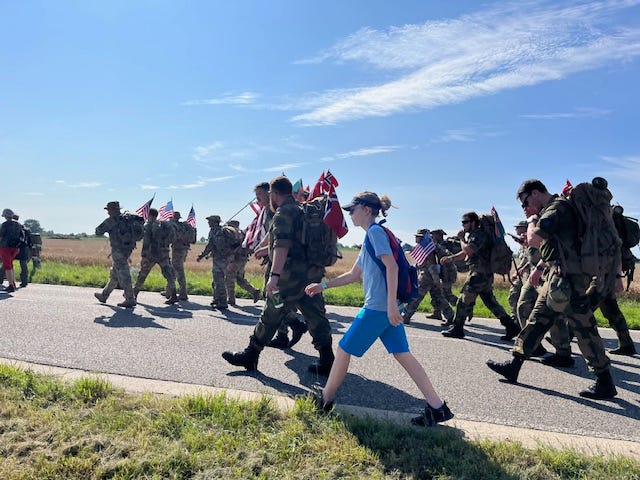
Comfortable shoes obligatory: The Nijmegen 4Days Marches
The Nijmegen 4Days Marches, also known as ‘The Walk of the World,’ attract over 45,000 participants annually. Find out more below...

Originally featured in DUTCH The Magazine in 2024. This piece has been republished with minor updates with permission from the original publisher. Thanks to the editor of the original piece, Paola Westbeek. Words and interviews by yours truly, Melita Cameron-Wood. This is a reader-supported newsletter, so please consider subscribing or buying me a “coffee” if you enjoy receiving this in your inbox.
The Nijmegen 4Days Marches, also known as ‘The Walk of the World,’ attract over 45,000 participants annually. Walkers can choose whether they want to walk thirty, forty or fifty kilometres per day (approximately eighteen, twenty-five and thirty-one miles), depending on their fitness levels—and how much they want to party upon their arrival in Nijmegen, where the route always starts and ends.
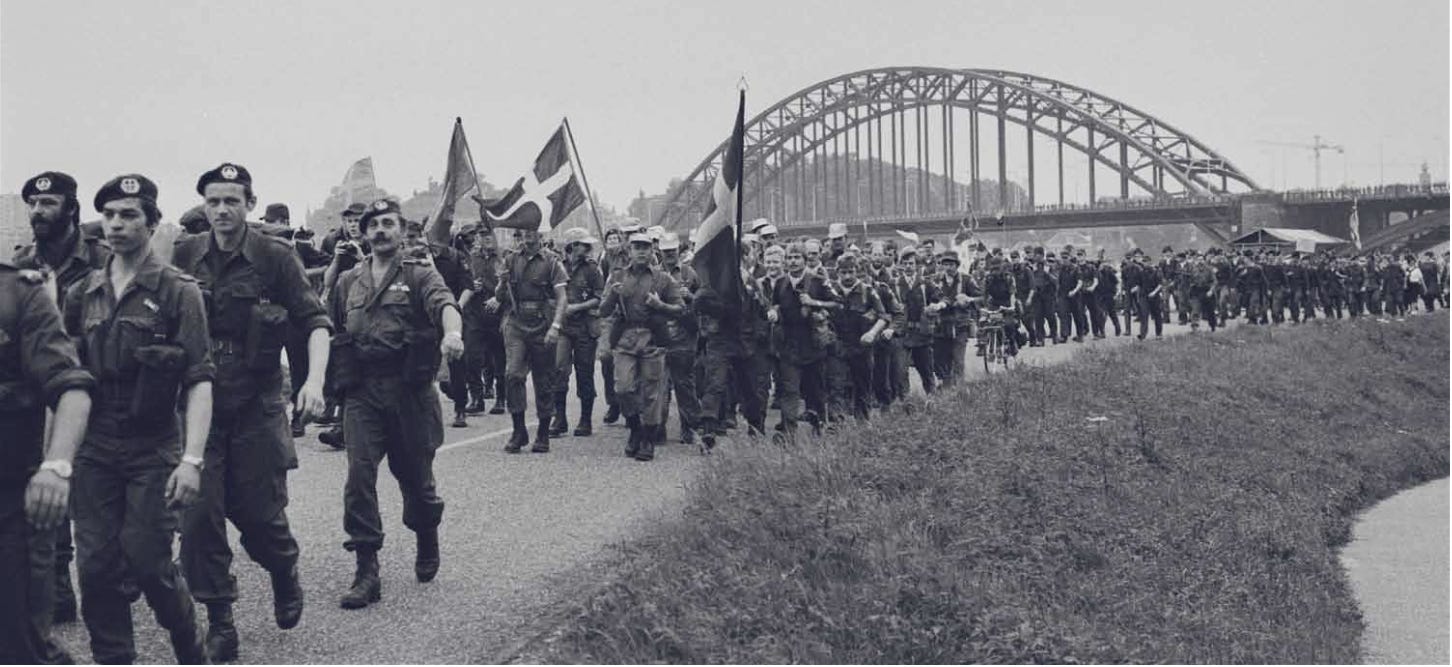
The event has undergone a radical transformation since its humble beginnings over 120 years ago. Originally conceived as a stamina-building activity for Dutch soldiers, the first 4Days Marches, which took place in 1909, had just 306 participants. There were ten different points of departure, all of which were army barracks. The walkers marched fifteen alternate routes before joining forces again in Breda, a city in the province of North Brabant, in the southern part of the Netherlands.
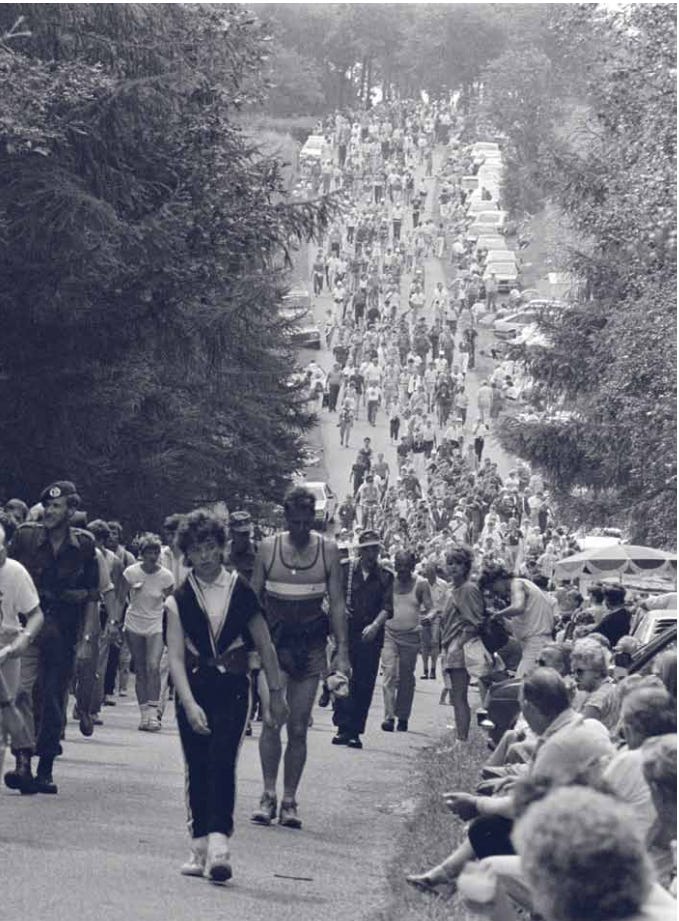
The number of routes turned out to be an organisational headache, so the subsequent year, all event participants started from the same place and walked the same route. In 1910, the chosen point of departure was Arnhem. It was only in 1925, after the walkers had tried out various starting points, including Den Bosch, Utrecht and Amersfoort, that the organisation settled on Nijmegen as the start and the end of the routes on each day. This decision was based upon the varied hikes around the town and the impressive hospitality shown to the walkers—brown beans, bacon, a bath and a bed can go a long way, it seems!
The 4Days Marches have also seen many landmark moments over the years, but the early 1980s were a particularly tumultuous time. Several protests were organised by the group of activists, Is het hier oorlog? (Are we at war?), which took a stand against the military style of the event.
The activist group was disqualified in 1984, as they chose not to cross the military bridge in Cuijk, a town near Nijmegen, out of principle. This sparked a debate in parliament and raised some tricky questions for the Dutch Ministry of Defence. In the early 1980s, anti-gay riots also took place at the Nijmegen Marches. In reaction to this, the event was transformed into one of the country’s biggest LGBTIQ+ celebrations, with the second day of the event now called ‘Pink Wednesday’ in celebration of inclusivity and acceptance.
In 1989, the first Russian soldiers participated in the event, and they were given accommodation in the same camp as American soldiers, Camp Heumensoord. Photographer Jan van Teeffelen famously took an iconic snapshot of a female American soldier kissing a Russian soldier during the event, which became a symbol of the end of the Cold War. In 1995, wheelchair users were allowed to participate for the first time, but there was some controversy around this, as these participants technically were not completing the event on foot. The organisational body only started awarding wheelchair users the official 4Days Marches Cross from 2009 onward.
To avoid overcrowding, the organisers introduced a limit to the number of participants allowed to take part in the event in 2005, as they noticed that the number of people signing up was too high for the infrastructure of Nijmegen. In its history, it has only been called off midway through the event once, in 2006, when record temperatures led to the hospitalisation of multiple walkers and the deaths of two participants. Since this tragedy, the event organisers have worked closely with a meteorologist and regularly inform walkers about the conditions they can expect during the 4Days Marches.
People travel from far and wide to participate in the event and often do so in groups to raise funds for charitable causes. UK breast cancer charity Walk the Walk is an example of such an initiative. They have been sending groups of walkers to the Nijmegen Marches for years, many of whom have a personal connection to cancer, whether that be through the loss of a loved one or their personal battle with the disease.
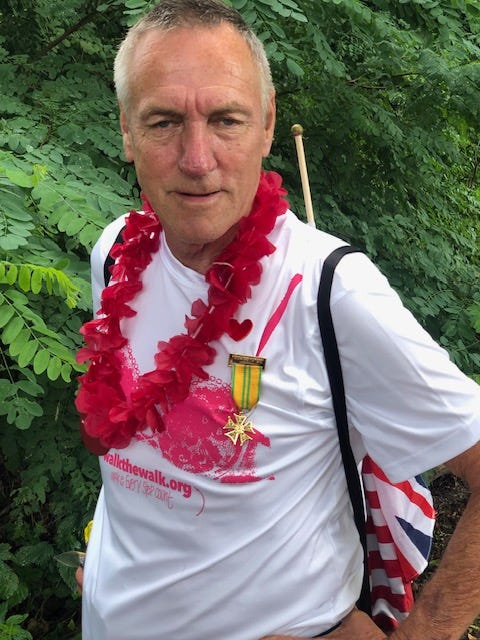
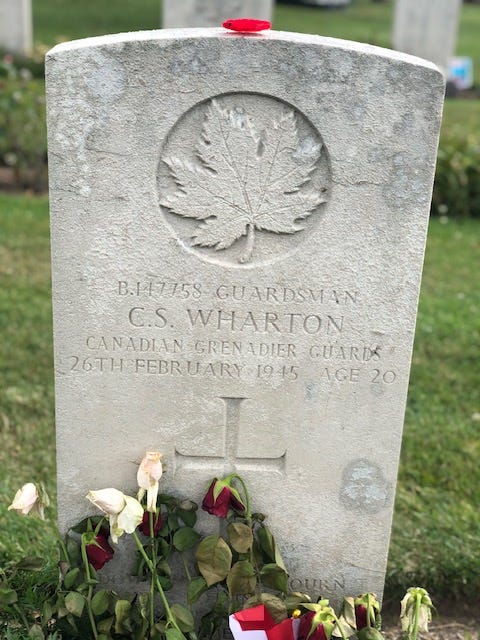
Seventy-year-old Canadian Mike Colbourne, who has now recovered from stage 4 bladder cancer, participated in the Nijmegen Marches with the Walk the Walk team in 2023. And he has become a regular participant. His participation in the event marks the fulfilment of a goal he set himself many years ago. “The Nijmegen Marches were always on my bucket list. I first found out about them in 1995. My mother and I were in Holland for the fiftieth anniversary of the liberation of the Netherlands,” Colbourne recalls. “My mum lost both brothers in the war. Her brother, Cecil Stanley Wharton, was a grenadier guardsman, killed close to Nijmegen. He was buried there and then moved to Groesbeek Cemetery.”
When Colbourne recovered from cancer after participating in an immunotherapy study, he knew he had to seize his chance to turn his dream into reality. His original plan was to march with the Canadian Legion, but as the Canadian army didn’t march in 2023 due to COVID-19, he went online and discovered Walk the Walk. “Our team was amazing. I was probably twenty years older than the rest of them,” Colbourne comments. “The most emotional moment I had was when our team stopped at Groesbeek Cemetery, where we laid Canadian flags on my uncle’s grave while the Last Post was being played.”
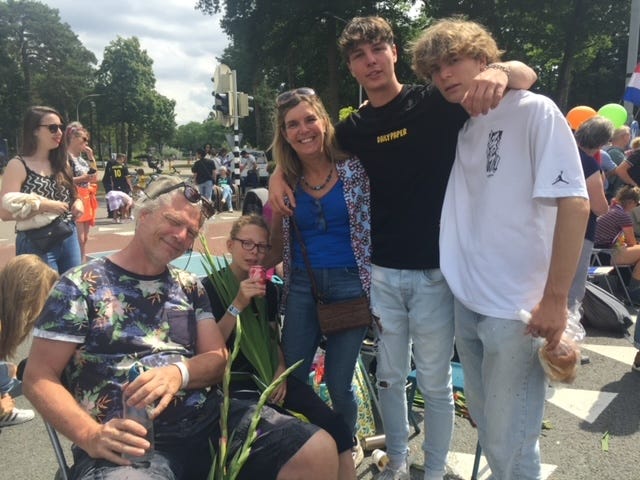
Other participants from the local area have fond memories of the event and have passed their enthusiasm on to younger generations. Astrid van der Looij, a local from Nijmegen, first participated in the event with friends from university in 1993, shortly after her graduation. “We had done our training, but it was still hard. I remember we cried together when we reached the finish line. We were exhausted,” she said.
The experience did not put her off, though, and she signed up again two years later with her partner Haaije Postma. Fast-forward to the present day, and they have now participated as parents with all three of their children. Ben, their youngest son, joined the event in 2022 for the first time at the age of twelve, the age from which participants are permitted to do thirty kilometres (eighteen miles) per day. “When I am tired and my feet are aching, I tell myself it is only a few more kilometres,” Ben commented.
“The hardest part was the last seven kilometres (four miles) on the Via Gladiola. The best part was the hilly zevenheuvelenweg (Seven Hills Road) between Groesbeek and Nijmegen.” As Ben’s parents are on the board of the charity Steppenomaden Mongolië (an organisation that raises money to support the Steppe nomad community in Sogog, Mongolia), he is using his participation in the Nijmegen Marches to raise money for this cause.
This year’s 4Days Marches are due to take place from 21 to 24 July. Like every year, walkers will descend upon the town of Nijmegen for a memorable sporting event that sees them push their physical boundaries, gather in groups and support each other to the finish line. During the festivities, walkers and non-walkers can enjoy live music, food, theatre, dancing and market stalls set up throughout town. In short, in the words of Astrid van der Looij, “It is hard not to have a good time!”